INSIGHTS / THE DIGITAL PENGUIN
How to Get Roofing Leads: 9 Proven Ways
Every roofer we’ve worked with has asked the same thing in the first call: how to get roofing leads that actually answer the phone. Not names on a spreadsheet. Not a lead sold to four competitors before you’ve dialled. Booked inspections.
This guide covers nine methods, ordered roughly by how quickly they produce work. Where we have real numbers from accounts we manage, we’ve included them — including the ones that didn’t work.
Want a team to manage this for your roofing company? Explore our roofing Facebook ads and lead generation services, including CRM follow-up and appointment setting, or request a roofing ads review.
Where roofing leads actually come from
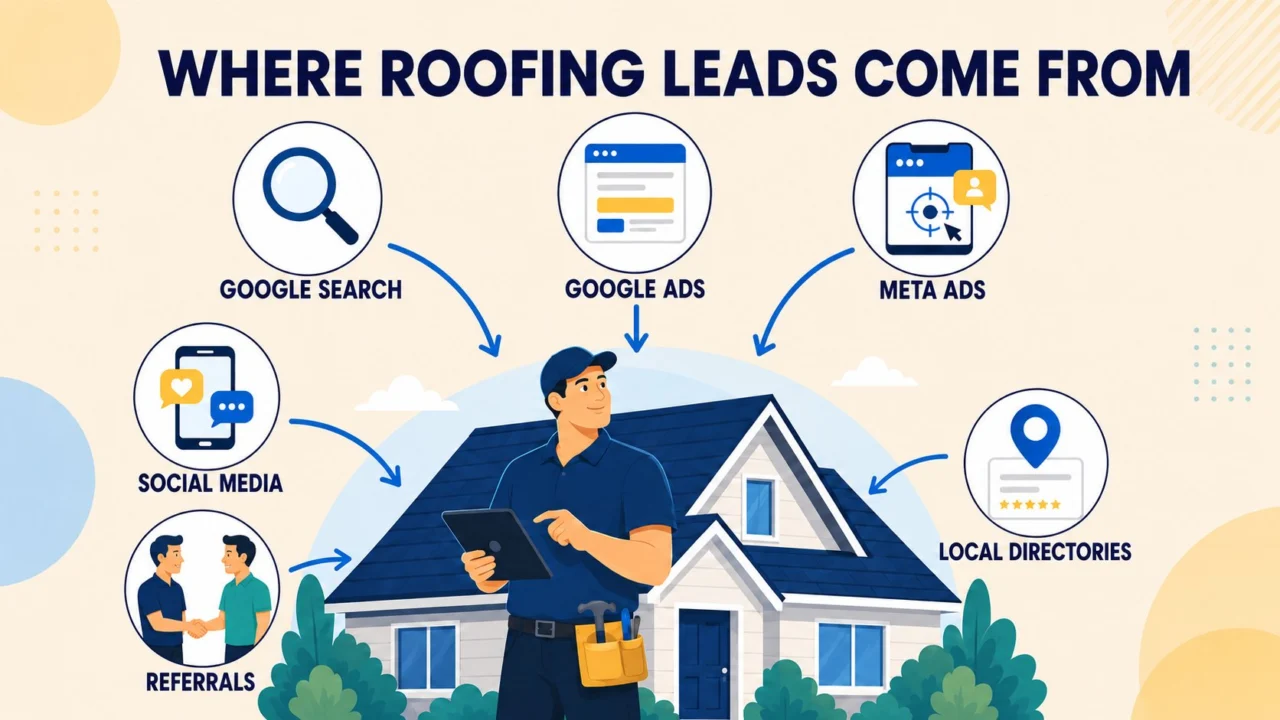
Six channels produce nearly all roofing work. The mistake most contractors make is treating them as alternatives — picking one, judging it after three weeks, then moving on. They compound. Paid creates demand, search captures it, reviews and referrals lower the cost of both over time.
1. Facebook & Instagram ads for roofing lead generation
Facebook and Instagram ads can introduce your roofing business to people in the areas you serve before they actively search for a contractor. Choose an offer that fits your actual services, such as an inspection, a repair assessment or a replacement estimate, and explain the next step clearly.
The historical campaign reports on our site include 163 website leads at $37.13 each for JP’s Roofing and 266 website leads at $50.85 each for Black Diamond Roofing. Those figures use the reporting periods and currencies displayed in each screenshot. They are advertising lead results, rather than a fixed price offer or a count of signed roofing jobs. Read the Black Diamond Roofing Facebook ads case study to see the evidence and how to assess it.
Choose instant forms or a landing page around the information your team needs and test the enquiry journey. Ask enough to establish service location, project type and an appropriate next step. Connect enquiries to your CRM, agree response coverage and review qualified conversations and attended inspections alongside cost per lead.
2. Google Ads and Local Services Ads
Google captures people already typing “roof repair near me”. Intent is higher than Meta, and so is cost per click — but these leads convert faster because the homeowner has already decided they need a roofer.
Local Services Ads are worth separating out: you pay per lead rather than per click, and you get the Google Guaranteed badge above regular results. For roofers with good reviews, LSAs are often the cheapest qualified lead available.
3. Insurance and storm restoration work
Contractors often ask how to get roofing leads from insurance companies, expecting a referral relationship that doesn’t really exist. Insurers don’t hand out contractor leads.
What works is being the roofer a homeowner brings to the claim. That means campaigns built around the claim process — free storm damage inspection, help documenting the damage, working with the adjuster — triggered after hail and wind events in your service area. Public adjuster relationships also produce steady commercial work, though that’s networking rather than marketing.
4. From ad to booked job: the follow-up gap
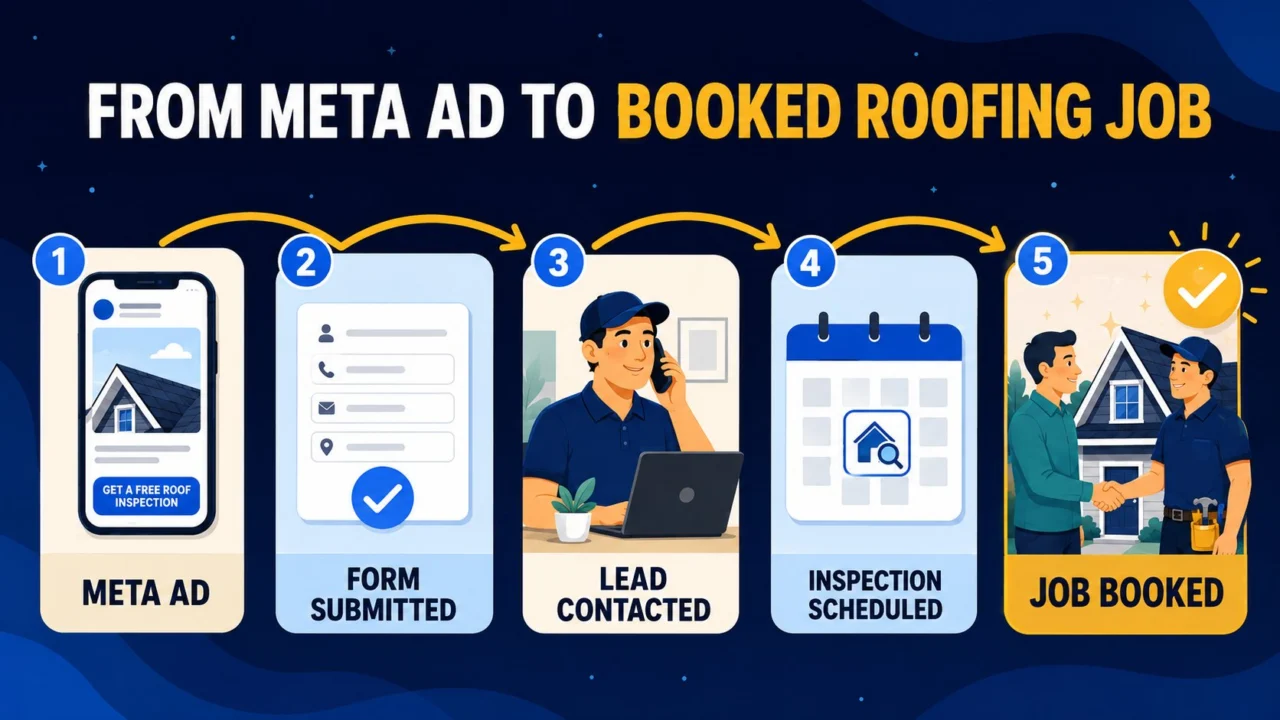
This is where most roofing companies lose money, and it has nothing to do with lead quality. A roofing lead contacted inside 60 seconds converts dramatically better than the same lead called back the next morning — because by then they’ve submitted forms to two competitors.
If you’re wondering how to get more roofing leads without raising your budget, fix this first. Cutting form fields, adding a click-to-call option and automating an instant SMS routinely lifts booked jobs 30–50% on identical spend. It’s cheaper than buying more clicks.
5. Google Business Profile and local SEO
The free channel that actually scales. A complete profile with real photos, service areas and a steady flow of reviews wins the local map pack — which is where a large share of “roofer near me” traffic lands.
This is also the answer to how to get free roofing leads. They’re not free exactly — they cost time and consistency — but there’s no ad spend. The trade-off is that you can’t turn them up on demand. If you need ten jobs next month, you need paid.
6. Reviews and referrals
Roofing is a trust purchase on an expensive, infrequent job. A 4.8 rating with 90 reviews beats a 5.0 with six, every time. Ask for the review at handover while the relief is fresh, not by email a fortnight later.
Adjacent trades are underrated: gutter installers, siding contractors and solar companies are on roofs constantly and see damage before homeowners do. A simple reciprocal arrangement produces steady work at zero cost.
7. Commercial roofing leads
How to get commercial roofing leads is a different playbook entirely. Property managers and facility teams don’t respond to storm creative on Facebook — they search.
Google Search around flat roof, TPO, EPDM and roof maintenance contracts works far better, alongside LinkedIn outreach and direct relationships with commercial property managers. Volume is much lower and sales cycles run months, but one contract can be worth twenty residential jobs.
8. Lead brokers — and why we’d avoid them
Angi, HomeAdvisor and Networx will sell you leads today. The catch is that the same homeowner is sold to three or four contractors simultaneously, so you’re racing to the phone and competing on price before you’ve said a word.
Cheap per lead, expensive per booked job. And you build nothing — stop paying and the pipeline dies that day.
9. How to get roofing leads without door knocking
Door knocking still works after storms, and some crews are excellent at it. But it doesn’t scale, it burns your best salespeople, and in a lot of neighbourhoods it now hurts your brand more than it helps.
Everything above replaces it. The honest version of how to get leads for roofing jobs at scale is: Meta for volume, Google for intent, Google Business Profile and reviews for the free layer, and follow-up fast enough that the lead is still warm.
What roofing leads cost
Across accounts we manage, cost per lead runs $37–$73, blended around $58. Four things move it: market competitiveness, service radius, season (storm season pushes cost down because demand spikes) and budget size.
The number that actually matters is cost per booked job. A $15 shared lead sold to four roofers is worse value than a $60 exclusive lead that answers the phone.
Roofing leads in the USA, Canada and the UK
Search behaviour differs more than you’d expect. American roofers search “roofing leads” — they want to buy them. Canadian and British roofers search roofing SEO and roofing marketing — they’re looking for help getting found.
In the UK especially, the demand is around SEO for roofing companies and local SEO for roofing companies rather than lead purchasing. Less storm-driven work, more repairs, flat roofs and re-roofing, with longer consideration cycles — so nurture matters more than raw volume.
The bottom line
There’s no single best channel. Run Meta for volume and Google for intent, fix your follow-up speed, and let reviews and Google Business Profile compound underneath. Judge everything on booked jobs, not leads.
If you’d rather not build that yourself, that’s what we do — exclusive roofing leads generated in your own ad accounts, with a 15-day trial and the real screenshots to back it up.